


Welcome to the Drip of the Week – your quick hit on companies we like, what’s changing across the Unicorn economy, and how those shifts impact employees and founders of the companies shaping our future.
Spotlight: Databricks
Databricks just raised a significant round at a ~$134B valuation, reinforcing its position as one of the most durable and strategically important private technology companies in the market today. What stands out isn’t just the headline valuation, it’s the quality and consistency of the business underneath it.
Why We View Databricks as an Evergreen AI Asset
Databricks offers something increasingly rare in AI: durable, compounding exposure to AI adoption without reliance on the large language models (LLM) business model itself.
Rather than betting onwhich LLM model wins the AI arms race, massive spending to build data centers and grab market share, orbusiness models that prioritize scale today over profitability tomorrow,Databricks sits beneath the entire AI stack. It monetizes data storage, data pipelines, analytics, and AI workloads regardless of which model wins.
As consumers and enterprises deploy OpenAI, Anthropic, xAI, open-source models, or proprietary internal models, Databricks captures value either way. This is what makes it feel evergreen, and recent performance supports this position.
- Sustained, strong year-over-year growth
- Multi-billion-dollar revenue run-rate with meaningful scale already achieved
- Exceptional net revenue retention, reflecting deep customer embedment
- Expanding share of wallet across data warehousing, AI, and analytics workloads
- Continued positive free cash flow over the past year
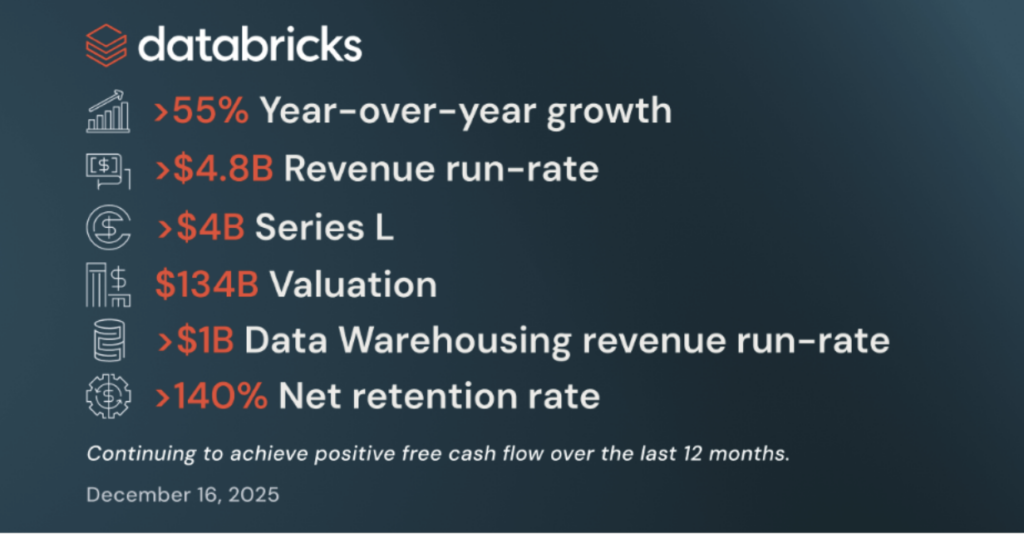
Databricks feels less like a typical late-stage unicorn and more like a core infrastructure giant that compounds quietly and becomes harder to displace over time.
Why It Matters
For shareholders, businesses like Databricks pose a familiar yet challenging question: when liquidity eventually arrives, how much upside will you still own?
Selling shares to solve near-term liquidity can seem prudent, but it often comes at the cost of long-term compounding and a large tax hit, particularly when the underlying company continues to scale, expand margins, and attract durable institutional capital.
When we model different paths to liquidity for Databricks shareholders, selling equity today versus financing against it, the difference can be substantial. In many cases, preserving ownership while accessing liquidity can translate into millions of dollars of additional long-term value, assuming the company continues on its current trajectory.
This dynamic becomes even more important when the asset in question shows characteristics of an evergreen business: strong retention, expanding use cases, and a long runway for growth well beyond the next liquidity event.
What To Do
If you know anyone who holds Databricks shares (whether they were employees or investors), this is a good moment to step back and evaluate their position which has likely grown tremendously in value. Liquid Stock works with Databricks shareholders and their advisors to model sell-versus-finance scenarios, helping individuals access liquidity while keeping more equity working for them over time.
Reach out to hello@liquidstock.com, visit our website, or setup a meeting to get connected.
Liquid Stock does not provide financial, tax or legal advice, and does not provide loans or consumer lending products. This communication is intended solely for informational purposes and should not be construed as an offer to sell, a solicitation of an offer to buy, or a recommendation of any security or investment product. Liquid Stock is not an official provider or partner of Databricks. Nothing herein should be considered personalized financial, tax, or legal advice. Any investment or tax-related decisions should be made in consultation with qualified tax, legal and financial advisors.